Welcome
to the website of the
LOUGHBOROUGH
AND DISTRICT AMATEUR RADIO CLUB
(Callsigns
G3RAL and G7RAL)
This
is a temporary landing page. Please check back in the near future to
find out about the history of our club.
Our
QRZ.com page is here.
Club meetings
The club meets on Tuesday evenings from 19:30 to about 21:00 at the Glenmore Centre, Thorpe Road, Shepshed, Loughborough LE12 9LU
(unless indicated otherwise).
The programme for the upcoming meetings is as follows:
September 2026
- 15th September - CHANGE OF SCHEDULE AND VENUE: Visit to Nunsfield House Amateur Radio Group (Nunsfield House, 33 Boulton Lane, Alvaston, Derby DE24 0FD). Meet 19:30 on site. Or contact us on the night on 145.425 MHz FM from 19:30 BST onwards. No meeting at the Glenmore Centre.
- 22nd September - An Audio Amplifier - Ian G8SNF
- 29th September - Practical evening
October 2026
- 6th October - Antenna Roundup - Phil G4DCI
- 13th October - ChatGPT - John M0IUB
- 20th October - Vintage records (78s) - Ian G8SNF
- 27th October - History of Hough Mill - Andrew G7SEG
November 2026
- 3rd November - meeting downstairs: Quadrophonics SQ - Ian G8SNF
- 10th November - To be confirmed - Peter G6KUI
- 17th November - Club Annual General Meeting - start 20:00 prompt!
- 24th November - Practical Evening
December 2026
- 1st December - Switch Mode Power Supplies - Andrew G7SEG
- 8th December - Paper planes
- 15th December - Natter Night
- 22nd December - Party Night
- 29th December - No meeting
** Note: Programme may be subject to change. **
For further information please contact Chris G1ETZ on 01509 504319.
Propagation conditions
HF propagation prediction and solar data from the website of Paul L Herrman N0NBH:
https://www.hamqsl.com/solar.html
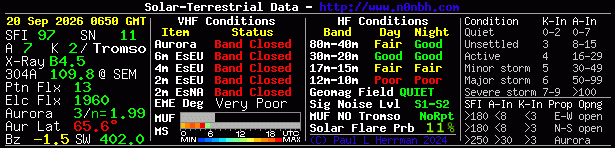
HF Propagation predictions are just that, predictions calculated using the available data. Of course, actual conditions at your location depend on a lot of additional items. The only sure-fire way to determine if the bands are open is to fire up that HF rig and get on the air!
Data for VHF Conditions is from DXrobot - Gouda, Make More Miles on VHF, and Andy (G7IZU) (all used with permission).
Data for Solar Flare Probability is from University of Bradford (used with permission).
Data for solar data and conditions from NOAA SWPC, solar flux from Space WX Canada, MUF data from Lowell GIRO Data Center (LGDC), solar images from NASA, and world map/globes/solar system from Fourmilab (credit given).
Description of the various values in the graphic above (from HamQSL.com and solar.w5mmw.net):
- SFI: Solar Flux Index. This is the intensity of solar radio emissions at 10.7 cm (2,800 MHz). The SFI represents the level of overall solar activity. From 62.5 to 300, higher is better. The Solar Flux Index is a good indication of the F-Layer ionisation (the layer that gives us most of our DX on HF). The higher the number, the greater the level of ionisation is, and the higher the frequency. Measured once daily.
- SN: Sunspot Number. Derived from the number of sunspots + groups. From 0 to 250, higher is better. Updated once daily.
- A: A-Index. Describes the Average Geomagnetic Activity. When used with K-Index: Both values high indicates that the geomagnetic field is unstable, and HF signals are prone to sudden fades, and some paths may close while others open up abruptly and with little warning. High K index/low A index indicates a sudden, abrupt disturbance in the geomagnetic field, which can cause an intense but brief disruption in HF propagation, but can cause an auroral event. Updated once daily.
- K: Kp-Index (Planetary K-Index). Describes Geomagnetic Field Disturbance. From 0 to 9, lower is better. Measures disturbances in the horizontal component of earth's magnetic field. Updated eight times daily.
- X-Ray: Describes the intensity of hard X-Rays hitting the earth's Ionosphere. A, B, C, M, X indicates magnitude (values range from A0.0 to X9.9). This impacts primarily the D-layer (HF absorption). The letter indicates the order of magnitude of the X-rays (A, B, C, M and X), where A is the lowest. The number further defines the level of radiation. Updated eight times daily.
- 304A: 304 Ångström value. Total Solar Radiation at 30.4nm (emitted by ionised Helium). Value ranges from 0 to unknown.
The number describes the relative strength of total solar radiation at a wavelength of 304 Ångström (or 30.4 nm), emitted primarily by ionised helium in the sun's photosphere. Updated hourly.
- Ptn Flx: Proton Flux. Describes the density of charged protons in the solar wind. Value ranges from 0 to unknown. The higher the number, the bigger the impact on the Ionosphere. Proton Flux primarily impacts the E-Layer of the Ionosphere. ≥10 pfu signals an S1 radiation storm & possible polar HF absorption. Updated hourly.
- Elc Flx: Electron Flux. Describes the density of charged electrons in the solar wind. Value ranges from 0 to unknown. The higher the number (>1000), the bigger the impact on the Ionosphere. Electron Flux primarily impacts the E-Layer of the Ionosphere. Updated hourly.
- Aurora: Aurora activity level (0–100). Indicates how strong the F-Layer ionisation is in the polar regions. Higher values cause auroral events (including northern/southern lights) to move to lower latitudes. Updated every 15 minutes.
- Aurora Latitude: Estimates the southernmost latitude where aurora may be visible. Calculated value from 67.5 degrees to <45.0 degrees. Updated every 15 minutes.
- Bz: Bz Component. ACE Satellite reported value from +50 to -50. Strength and direction of the interplanetary magnetic field as impacted by solar activity. Positive is same direction as the earth's magnetic field, and negative is the opposite magnetic polarity. Cancels out earth’s magnetic field when negative, which increases the impact of solar particles in the ionosphere. Updated hourly.
- SW: Solar Wind. Speed of charged particles (Solar Wind) in km/s as they pass Earth. Typically 0-1000, lower is better. The higher the speed, the greater the pressure that is exerted on the Ionosphere. Values greater than 500 km/s have impact on HF communications (contributes noise). Updated hourly.
VHF Conditions:
- EsEU: Sporadic E Europe. Reports 'Band Closed', High MUF when 2M only is open, or 50/70/144MHz ES when the respective band is reported open. Updated every half hour.
- EsNA: Sporadic E North America. As above.
- EME Deg: Earth-Moon-Earth Degradation. Reports EME path attenuation as Very Poor (>5.5dB), Poor (4dB), Moderate (2.5dB), Good (1.5dB), Very Good (1dB), Excellent (<1dB). Updated every half hour.
- MUF: Maximum Usable Frequency (MUF) in MHz at Tromsø in northern Norway in a coloured bar. Grey indicates No Sporadic E (ES) activity, blue indicates ES reported @ 6M, green indicates ES reported @ 4M, yellow indicates conditions support 2M ES, and red indicates reported @ 2M. Updated every half hour.
- MS: Provides the Meteor Scatter activity in a coloured bar. Grey indicates no activity. See the colour coded graph at the bottom of the bar for activity level. Updated every 1/4 hour.
HF Conditions:
- Geomag. Field: Geomagnetic Field. Calculated value. Indicates how quiet or active the earth's magnetic field is based on the K-Index value. Reports as Inactive, Very Quiet, Quiet, Unsettled, Active, Minor Storm, Major Storm, Severe Storm, or Extreme Storm. Higher indications can cause HF blackouts and auroral events. Updated every three hours.
- Sig/Noise Level: Signal to Noise Level. Calculated value. Indicates how much noise (in S-units) is being generated by interaction between the solar wind and the geomagnetic activity. The more active and disturbed the solar wind, the greater the noise. Updated every half hour.
- MUF NO Tromso: Provides the Maximum Usable Frequency (MUF) reported at Tromsø in northern Norway. Value from 0 to 100 MHz. NoRpt = No Report. Updated every 15 minutes.
- Solar Flare Prb: Solar Flare Probability. Reports the probability (in %) of a solar flare within the next 24 hours (0-100%). Updated every hour.
Mills on the Air 2026
On Sunday 10th May 2026 we once again participated in the annual Mills on the Air event, which is intended
to bring together amateur radio operators and clubs to promote the hobby, whilst helping preserve some
of the wonderful heritage of our Windmills and Watermills.
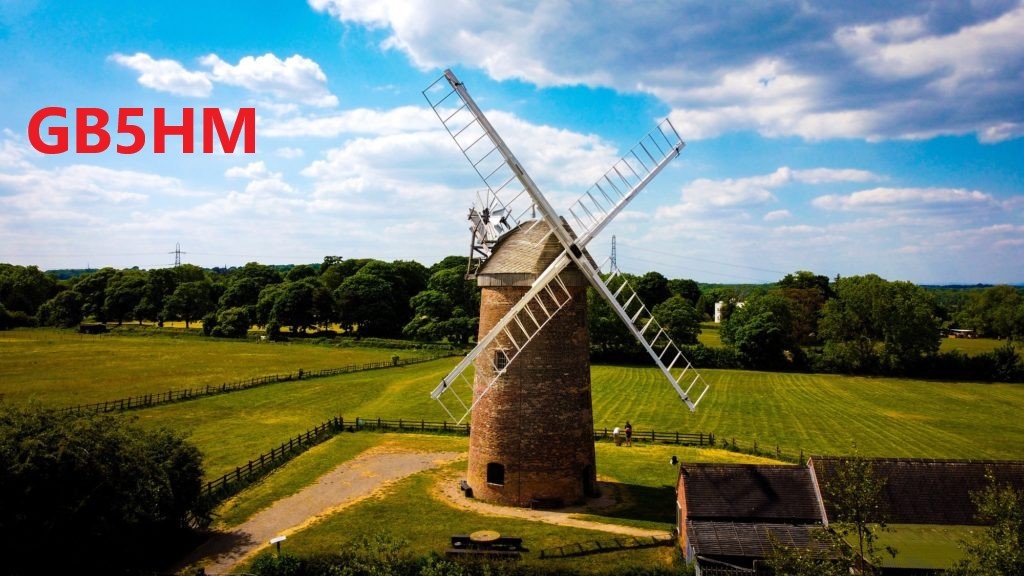
LADARC club members operated a Special Event amateur radio station with the callsign GB5HM at Hough Mill
in Swannington in North West Leicestershire.
Like last year, we operated a HF station and also ran a station on the 2 metre band.
While propagation conditions were not great this year, we still contacted stations all around Britain
as well as in Ireland, Belgium and Germany.
Look out for an article in Radcom later in the year with a more detailed report on our activation.
©
2026 Loughborough and District Amateur Radio Society
Last
update: 11.09.2026